In Northern Philippines, Tattoo Artists Attract Travelers in Search of the Most Original Keepsake

I’m sitting on the balcony of my homestay in Buscalan, a remote mountain village in northern Philippines, reviewing a sheet of tribal tattoo designs with English descriptions: intersecting arrows around layered squares (to represent a compass), zigzagging rows of blackened triangles (mountains), a chain of triangular hourglasses (day and night). Below me a narrow path winds through muddy rice paddies like a snake and disappears into a horizon blanketed by dense fog.
January is the middle of the dry season, but the clouds insist otherwise; raindrops are plunking out a tune on the corrugated metal roof. I decide on a circle orbited by dots and waves: the sun. Maybe this tattoo will usher in the light. This is my third trip to the Philippines, the country my parents left five decades ago. Reaching Buscalan was challenging, starting with a stomach-churning 12-hour drive from Manila through the Cordillera mountains, then a one-hour hike into a ravine of fragrant laurel trees, and finally a rickety tram—a narrow wood crate with a pulley system powered by a stationary Jeep, originally meant for transporting supplies.
Still, none of this deters the most resolute. In place of physical souvenirs from my travels, I get body art as intentional scars archiving my journeys. They are always celestial objects: I have another sun, from Melbourne, a magenta star from Budapest, and an emerald constellation grown over multiple trips to Dublin. Now a Kalinga design will be tapped dot by dot into my skin by a mambabatok, a traditional tattooist.
Buscalan is famously home to the oldest living
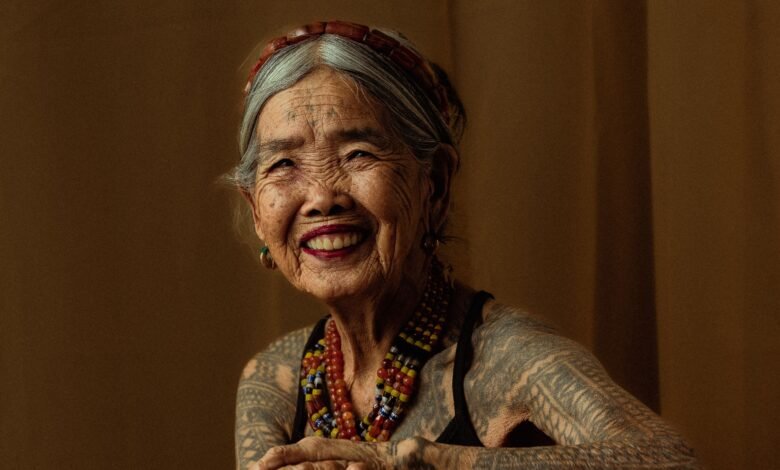
Buscalan is famously home to the oldest living artist in the country: 109-year-old Apo Whang-od (whose birth name is Maria Oggay), a woman with arms completely covered in twisted, inky patterns who has been practicing hand-tapped tribal tattoos for over 90 years. Bamboo tattooing was an art initially done by Kalinga men, but Whang-od’s father recognized her artistic talent. So he guided her in making intricately layered designs, like woven fabric, to adorn warriors’ chests as marks of honor.
Her signature tattoo now is a cluster of three dots that represent herself and her two grandnieces—the next generation of mambabatoks. If there are holy grails of tattooing, getting inked by Whang-od is certainly one of them. As I arrive in Buscalan, I pass a group of hikers who are devouring bowls of steaming rice with fatty pork, purchased from a shack set up at a lookout. I overhear one say that Whang-od was taken to a hospital 50 miles away because of an illness and won’t be returning to Buscalan for several days.
Whang-od’s tattooing has developed a micro-economy in the surrounding province, which, by Kalinga Office of Provincial Tourism estimates, receives 40,000 visitors a year. But no one can make an appointment, and, as I quickly learn, there is no guarantee that Whang-od will be available. Fortunately, her protégées—her grandnieces and other female students in the village—are skillful artists in their own right.
My mambabatok, Princess Sarah Baydon, who looks
My mambabatok, Princess Sarah Baydon, who looks to be in her 20s, is one of them. She meets me at my homestay, and I am immediately warmed by the similarity of our faces. I ask Baydon about her connection to Whang-od. “She taught me,” she assures me. “She taught all of us.”
Baydon tells me that Kalinga tattoos combine patterns and symbols to represent the natural and spiritual worlds.
A row of triangles with spiky tops—signs of fertility and good health—are inspired by the palmlike ferns that line the craggy trails around us. Tiers of honeycomb hexagons resembling snake skin indicate strength, and the circular sun symbol I chose means life. Baydon’s tattoo needle is a spiky thorn of a pomelo tree attached to a thin bamboo reed. She thwacks the tip of the thorn into my back with precise taps from a wood baton.
Then she rubs her finger in a pot of charcoal soot mixed with water and dabs it into my pierced skin. It’s a stinging pain; at times I feel only her hands brushing away the ash from my shoulder. When the tapping elicits an electric jolt, I inhale deeply, taking in Buscalan’s misty cool air that carries the scent of mossy earth and sugary coffee. Baydon has been tattooing since 2016, she says, when she started observing Whang-od and practicing on her friends.
I love that my mambabatok may well be Gen Z’s Apo Whang-od, and that a centenarian artist connects us through this craft, these tattooed symbols of our shared homeland. When I depart Buscalan the next day, the fog has been hastened away by the overnight rain. Every few steps of the hike out, I tap my fingers on my back so I can feel the buzzy warmth of a sun that I will carry with me everywhere I go.
Source: www.cntraveler.com